
Being good but ineffective isn't good enough


It’s a strange paradox — you have on the one hand a sector with hundreds of thousands of people who really care about people and want to make a positive difference to their lives. Good people, skilled people who may have given up higher salaries to work for purpose. They are the kind of people we are taught by our parents to be, and some of the best people I have had the privilege to meet and work with. Yet despite all that effort and purpose and heart, the social sector struggles to make the impact that everyone wants it to make.
The intention to do good is there, but the outcome, the results, especially long term, are often poor. Progress is often slow, unevenly distributed, inconsistent, with huge variation between the best performing programs and the rest. Data on what works is slow and often not nuanced, so it’s hard to even know what programs or methods are working in what context for what needs. Good programs struggle to spread to new places, programs often don't achieve potential at the implementation level, ideas get reinvented and innovation is cumbersome and often resisted by staff. It feels like the social sector is stuck in the slow lane compared to what is happening in the rest of the world.
Contrast this to the private enterprise world where people often struggle with motivation and moral purpose, yet the market incentives drive continuous innovation. Many modern tech businesses have made decisions that breach trust and privacy, manipulate and hurt people (looking at you Meta), but they continue to gain power, influence and income despite this. This accumulation of power (through M&A and market consolidation) also leads to choice narrowing and income inequality. They are effective at what they do even when profit-seeking creates negative effects on others.
What’s a way to understand this difference? Could the social sector borrow some of the techniques that make commercial organisations effective, while staying close to their moral purpose? I believe they can.
Elements that drive effectiveness
The table below lists a range of elements that drive effectiveness and my comparison between how well-run private sector businesses use these elements, and how they often manifest in the social sector. It’s not exhaustive nor is it universal — there are exceptions but these are my observations from years of working with a range of both commercial and social organisations.
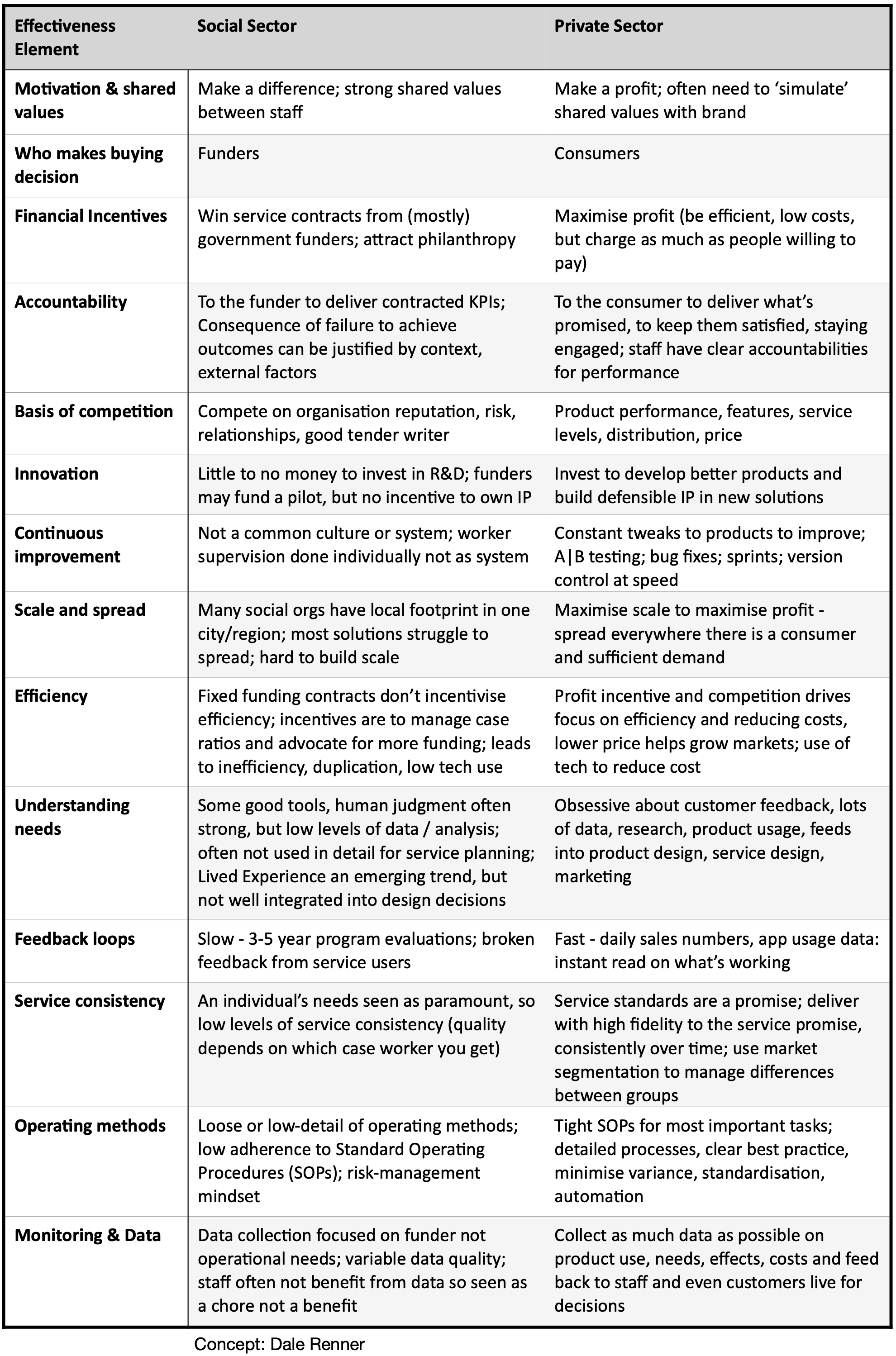
These elements could serve as an aspirational playbook for the social sector, noting that we need to borrow and adapt techniques from other places, not apply them directly.
Some of these differences are structural and hard to change. It’s hard to change the power dynamics and incentives driven by the fact that the State funds most social services. But there are concerted efforts to change this. One method that I’ve been involved in is Social Impact Bonds which try to align funding and outcomes via financial incentives (‘outcomes-based funding’). There’s plenty of work to do on how funders experiment with different ways to fund social services to create the right incentives to achieve outcomes. We need to work on improving the system, but not wait for it to be fixed before we act.
There are ways of working, habits and assumptions in the social sector that can be changed if we decide to change them, even without structural change. An individual social organisation can decide to improve its operations and impact as a matter of Mission even if funders are not requiring this of them. I’ve seen this kind of leadership in areas such as homelessness and child protection, where the Board of an organisation decides they must develop a solution to a problem and they then work hard to develop better service models and solutions. Sometimes this means funding the innovations with donations rather than government contracts. It often means challenging assumptions and belief systems within the organisation itself. But it is possible.
So where to start?
A social organisation has to accept that things are not good enough as they are — that change and improvement is vital to achieving Mission. Delivering contracted services is not the same as achieving impact. It must also decide that achieving the Mission, its social impact, is more important than short term finance, than the number of staff it employs, more important even than reputation. Such a strategic focus might mean deciding not to do some things (e.g. withdraw from some services) in order to maximise its social impact. If making a difference really is #1, then lots of decisions flow from that.
Consider some of the effectiveness elements that you can do something about right now:
- Accountability — what process could help keep beneficiaries’ needs at the centre, and help them keep you accountable for progress?
- Innovation — How do you set goals and involve staff in developing new solutions, testing and refining them?
- Continuous improvement — What methods and data are used to generate ongoing feedback on what’s working and what isn’t?
- Scale and spread — Set a strategic goal of creating great programs that can spread across your country or internationally.
- Efficiency — What systems help incentivise efficiency in your teams, so people reduce duplication and free up time for direct service?
- Understanding needs — How deeply do you understand beneficiaries’ needs and what can you do to learn more and be accountable to them?
- Feedback loops — In the absence of the commercial feedbacks (sales, profits, market share), what measures and tools help provide instant feedback on what’s working?
- Service consistency — How consist is the actual delivery of your programs between beneficiaries? How far are you from best practice?
- Operating methods — Is your practice well-documented and are staff getting just in time learning about how to solve edge-cases?
- Monitoring & Data — Forget what the funder wants: what data does your staff need to make better decisions in the moment?
We need to move out of the slow lane of innovation in the social sector. We can and should borrow, steal and adapt ideas from how nimble for-profit companies invent better services and solutions.
A note on this blog
This blog is just starting out, but it’s all about how we can learn to do better in addressing social issues. We’ll look at a range of these effectiveness elements and suggest ways that the social sector can improve. What methods, approaches, practices, mindsets do we need in order to speed up innovation? What specific challenges do you think need improvement in the social sector?
I’m drawing on my last 15 years working in the social sector in Australia (across many and diverse issues and organisations), and before that 14 years working in the commercial sector mostly as a management consultant across a range of industries. There are no easy answers, but we can advance and improve through sharing ideas, gathering data and being ambitious on innovation. My views are in no way claiming to be the only way, but aim to stir the debate about how we do better.